

My last chemotherapy dose was on the second of February, 2014.
By then I had stopped counting in weeks and started counting in battles. Six of them. Each one three weeks long — fourteen days of Xeloda tablets every twelve hours, one bag of Oxaliplatin through a drip, then a week off so my blood could come back to me. By the fifth battle my veins had had enough of the whole business. The nurses had to go hunting for them. My oncologist offered to put a port in my neck and I said no thank you, I will take the pain, it is only for a few days.
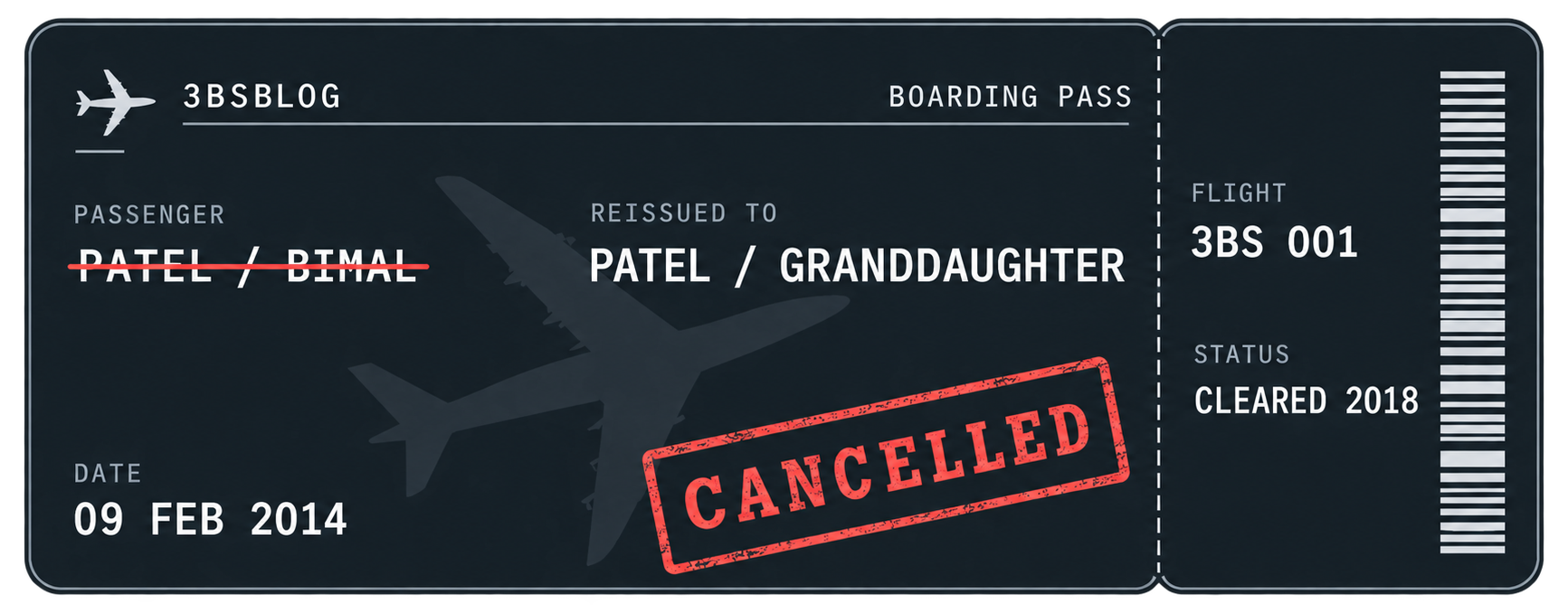
Seven days after that last dose, on the ninth of February, my granddaughter was born.
I had been writing my cancer story for nine months by then. I wrote it on my iPhone, in the Evernote app, lying flat in bed, because after the surgery I could not sit. Thirty pages, typed with two thumbs in the dark. I wrote about the diagnosis in India, at my niece’s wedding, where my friend waited until after the ceremony to tell me. I wrote about the twelve-hour operation. I wrote about the man from administration who came to my bedside at half past seven in the morning, on the day they were going to cut me open, to ask who should decide what happened to my body if things went badly.
Somewhere in all of that, I had started thinking about my own departure. I did not use that word. I am not a man who says the word. I said flight.
And then she landed, and I wrote this at the bottom of the last page:
My granddaughter’s flight has landed — and my flight is cancelled, to make room for her flight.
I did not think much of it at the time. It was one line, written by a tired man on a telephone in a dark room, at the end of a very long document. Thirteen years later I think it may be the truest thing I have ever written, because it turned out not to be a sentiment. It turned out to be a set of instructions.
What a cancelled flight actually means
It does not mean you are free. It means you are still standing in the airport, with all your luggage, and nobody has told you where to go next.
Here is the luggage. A permanent colostomy — a stoma on my left side, and a bag, for the rest of my life. Chemotherapy-induced peripheral neuropathy, which is a long name for the fact that during chemotherapy I could not touch metal below seventy degrees without pain shooting through my fingers, and that thirteen years later my feet still go cold in a way that no sock has ever fixed. No pulling, no pushing, no lifting over ten pounds. No lawn mowing. No snow blowing.
And two numbers given to me by science and medicine: a one-in-four chance that I would die of it, and a twenty-seven percent chance that even if I did not, it would come back and we would begin again. Small numbers on a page. Not small at all when they have your name written next to them.
So for five years I did not really live. I reported. Every three months I went back to the University of Chicago and they scanned me and looked for the enemy, and every three months I got a small piece of my life handed back to me on a temporary basis. You cannot make plans on a three-month lease. You cannot decide what to do with your seventies when you do not know about next April.
Then, in 2018, they told me I was clear.
That is the day the real problem started, and it is the day almost nobody writes about. Cancer treatment gives you a plan for every single day. There is a schedule. There is a room to go to, a drug to take, a person whose job it is to tell you what happens next. And then one afternoon it stops, and they hand you your life back, and there is no protocol at all.
Nobody told me how to sleep with a stoma. Nobody explained why my feet were cold. Nobody sat me down and said: here is how to build the next twenty years. I got a bag, a follow-up schedule, and a car park ticket.
What I decided to do with a cancelled flight
Three things. I have written them on the wall, and I mean them literally, not as a slogan.
No medicine until I die. I want to be clear about this one, because it is easily misunderstood. I took every drug they gave me in 2013. All of it. Radiation, Xeloda, Oxaliplatin, morphine, the lot — and I am alive because of it. What I mean is that I have spent thirteen years trying to earn the right not to need any more of it.
No nursing home until I die.
Stay mobile until I die.
These are not a biohacker's manifesto. They are a grandfather's arithmetic. My granddaughter is twelve years old. In 2013, lying flat after surgery, I could not even change my own bag — my son Abhishek had to do it for me. I am trying to engineer a life where my granddaughter only ever knows her grandfather standing on his own two feet, fully independent, and walking into the room under his own power on the day she gets married.
That is the whole reason. Everything else on this blog — the sleep data, the golden paste, the six categories, the protein formula, the arguing with an AI at three in the morning about a stoma pouch — is downstream of one line I typed with two thumbs in a dark room in February 2014.
What this is
In January of this year I started asking better questions. Not of doctors — I have excellent doctors, and I will name them, and they saved my life. Better questions of myself, and of an AI I have taken to calling my AI Vaidya, at the hours when no clinic is open. Six months and thirty-six chapters later I had a protocol that gets me sixty-nine minutes of deep sleep with a colostomy, and no night wakings, and no tablets.
On the fourth of July I gave the whole system a name. 3BsLog. Independence Day, which I did not plan and now cannot ignore.
I am going to publish all of it here. The war, the years afterwards that nobody warned me about, and the method — including the parts where the method was wrong, because those are the useful parts. If you are living with a stoma, or waiting on a scan, or standing in the airport with your luggage wondering where to go next, some of this will be for you.
A breast cancer survivor named Brandie Sellers wrote something I put at the top of my story in 2013, and I have not found a better reason to write in public since:
no one would be inspired if I sat at home in the dark.
So — not sitting in the dark. Starting here.
Next Wednesday, 14 October: thirteen years with a stoma. The things nobody tells you, and the four or five that actually matter.
Nice inspiring blog.