

In my first post I promised you this one for Wednesday 14 October. It is a week late. I found errors in the data behind another project of mine, and spent the week fixing them. Build on bad data and everything on top is wrong.
In the summer of 2013 a surgeon took out the part of me that was trying to kill me, and brought the end of my colon out through a small opening on the left side of my belly. That opening is the stoma. Over it I wear a bag. I will wear one for the rest of my life.
Before the operation I was frightened, and to be honest a little pessimistic. My daughter, Apeksha, turned me around. She pointed to my cousin, who was fighting cancer in her brain. “She has only one brain and no options,” she said. “Look at you. They cut here, join it at another place, attach a device, and you are up and running.” My cousin had been given six months to live. She lived four more years.
She was right. But nobody tells you what “up and running” actually involves.
The first weeks
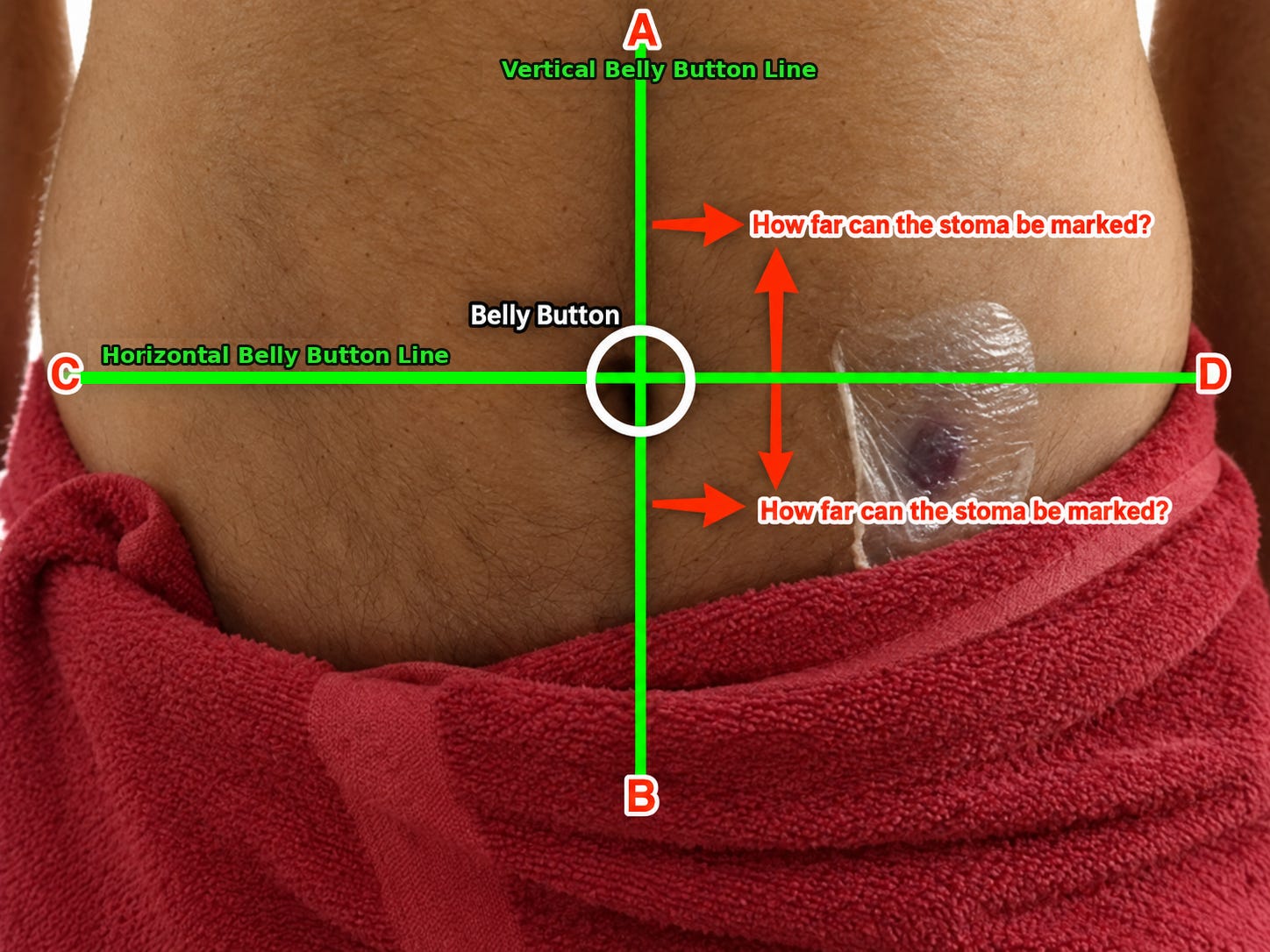
Before the surgery, my ostomy nurse and my surgeon marked the spot where the stoma would go: on my left, just below the line of my belly button.
They chose it so that I could wear normal clothes, sit normally and be a normal person. Thirteen years later I am grateful for that mark every morning when I get dressed.
The first days after were rough, and the gas pains were the worst. Surgery puts the bowel to sleep, and until it wakes up, nothing moves. Before the operation my body had its own system: stool reached the rectum, a reflex told me it was time, and I decided when to go. Now the rectum was gone, and that system with it. My bowel had to learn a new exit, like a child learning potty habits all over again.
Apeksha had done some research and told me to drink tea. I had not tasted tea in fifty-six years. I drank it. The gas came out, my stoma came alive, and I felt I was in heaven. Later I learned that surgeons in Germany had published a trial less than a year before my operation: patients who drank coffee after bowel surgery got their bowels working sooner. Nobody on my ward had mentioned it. For me, it was tea.
In the hospital my ostomy nurse, Michele, showed me how to change the bag. I called her my Guru then, and I still do. At home I did my first change myself, as the boss of the operation. In the weeks I was too weak, my son Abhishek was my hands: he changed my bags, dressed my wound and bathed me, under my instructions.
The things that actually matter
I promised you four or five things that matter. There are six, and they are what works for my body. Yours may be different, and your ostomy nurse is the person to ask.
A two-piece system. The flange stays on the skin; the pouch clicks on and off. It is easier to empty and it is cleaner. I use Hollister’s two-piece with the lockable flange. The lock, with its little handle, gives me confidence. Nobody pays me to say that.
Empty early, empty often. A heavy pouch pulls on the appliance and damages the seal. I empty the moment I feel heavy.
A little baby oil inside the pouch, so the output slides down instead of sticking.
Watch what goes in. The goal is output that is neither hard nor liquid, and what you eat and drink decides it.
Give the stoma a bath. You get a clean body, and every day you get a chance to inspect the skin around it for infection or any change.
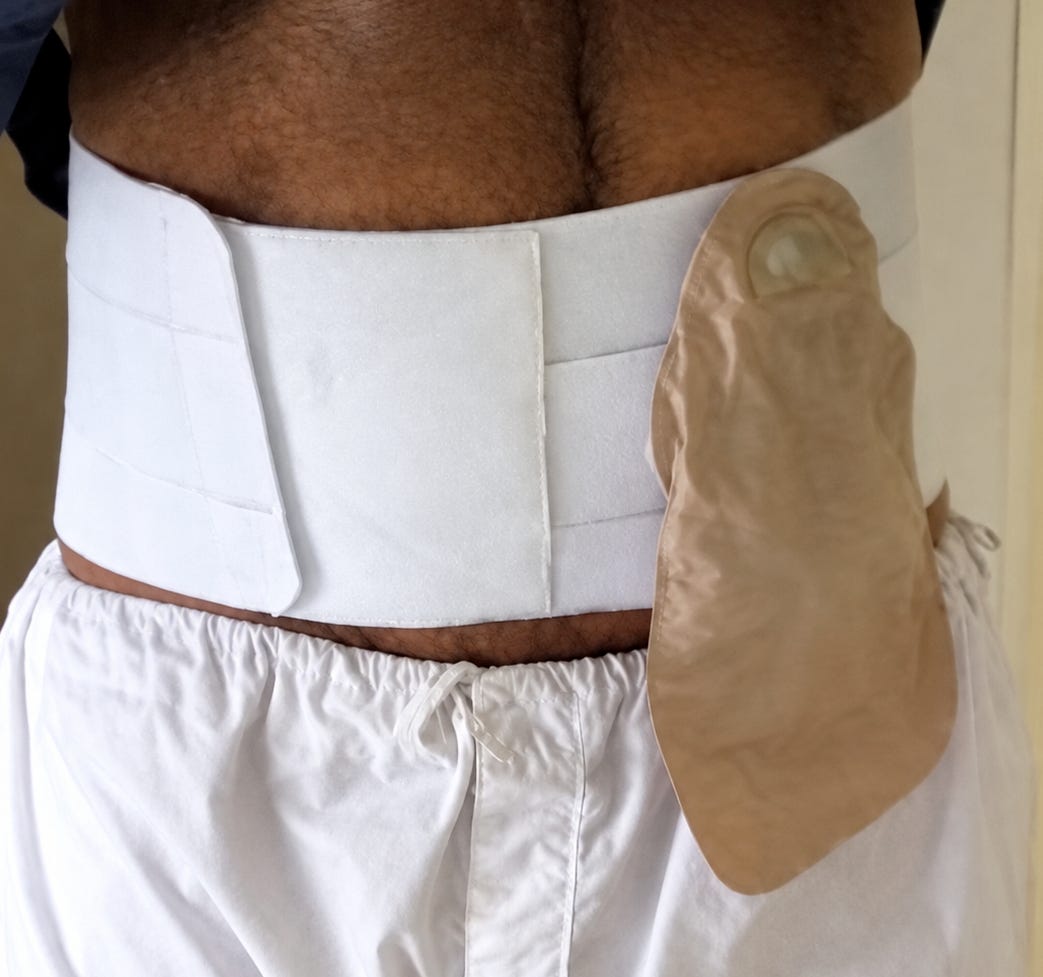
A hernia support belt. I have worn an ostomy support belt for thirteen years, whenever I walk, work or travel. It holds everything in place, so my intestine stays where it belongs. I am always aware I am wearing it. A belt is there for security, and security means there is something to protect.
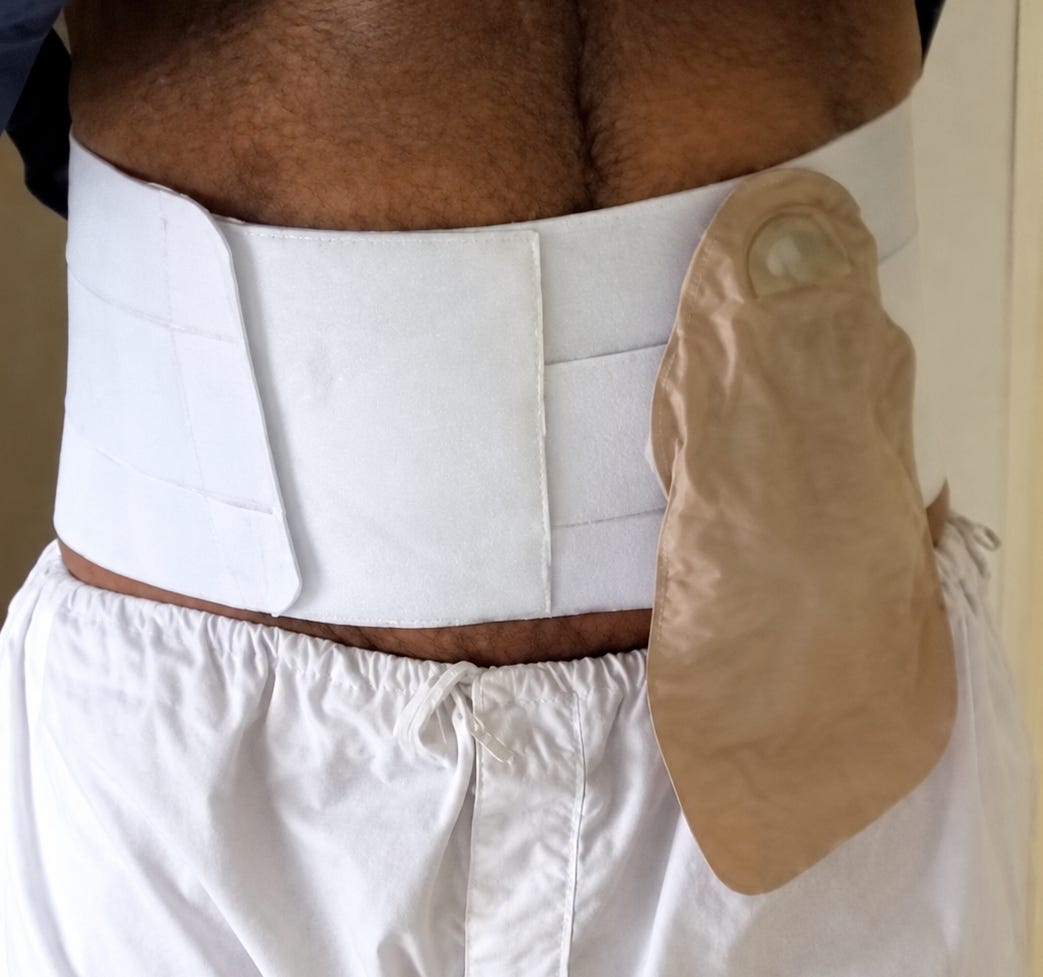
My ostomy support belt. I have worn one for thirteen years, whenever I walk, work or travel. Photo sharpened with AI
The liners I had to fight for
For some years I used the best product I have ever had: flushable, biodegradable liners that sit inside the pouch. When a liner is full, you flush it away, and the pouch stays clean.
Getting them was a fight. Medicaid did not cover liners at all, and my clinic could give me only two or three pouch changes per appointment. So I paid out of my own pocket, and the price went up every year until a single liner cost 55 cents. It stopped being affordable.
I also wrote to the manufacturer, and I did not hold back about how he was running his business. His reply was calm and professional. He had tried everyone from the government to the corner store, and in his view the big suppliers did not want a product that would cut into their own sales. I have always admired that in North American entrepreneurs: you can push them hard, and they answer with courtesy.
So I did what I have always done in business: I worked around it, and invented my own techniques for a clean, environment-friendly routine. That is a post of its own.
Later, when a supplier sent me poor-quality appliances, I simply changed supplier. Your stoma deserves quality, and you are allowed to choose.
The hard thing nobody told me
I wanted to travel and move around without fear. Nobody told me that a stoma turns you into a man with luggage.
Here is what goes everywhere with me. Pouches. Flanges. Scissors. Adhesive remover. A small air freshener. A small bottle of blue liquid that stops the smell. A travel roll of toilet paper. Loperamide tablets in case of loose motions. My diabetic finger-prick meter. My passport and travel documents. Photographs of my stoma with a letter from my doctor, because in those days the people at the security check had never heard of one. And two small cards from the United Ostomy Associations of America: one for security screening, one that asks a shop or office for urgent use of its restroom.
The meter once helped someone else: a woman in our social circle felt unwell, we measured, found her sugar had dropped, and got sugar into her straight away.
With all that to carry, I researched, and found a travel vest with forty-two pockets. It is a ScotteVest, and nobody pays me to say that either. Everything has its own pocket, and I made myself a pocket map so I know what lives where. The weight sits on my shoulders, not around my stoma. The one I wear now is my second in thirteen years, a birthday gift. I wear my supplies, and I go where I like.
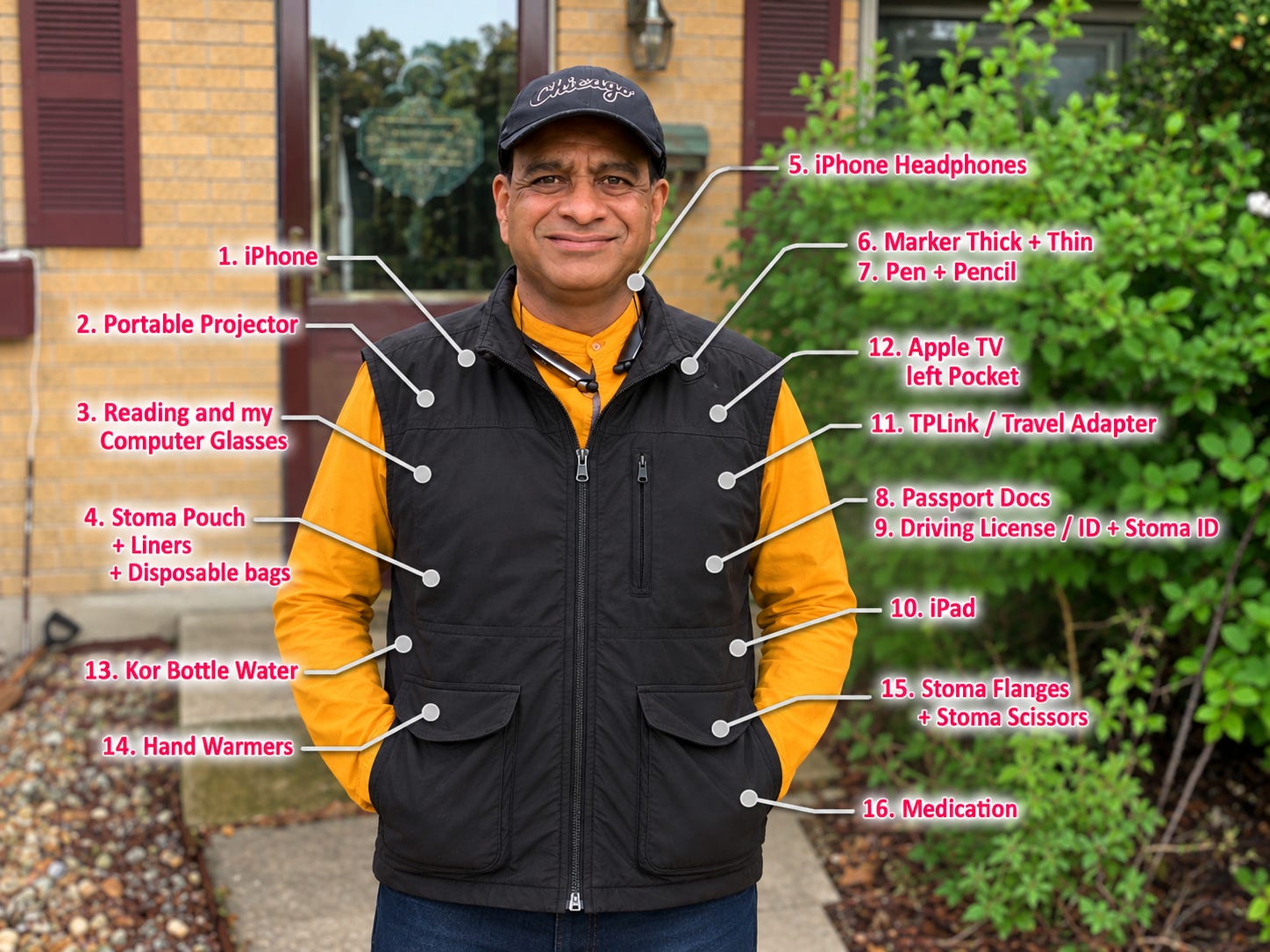
An ordinary day, thirteen years in
Ordinary. That is the point.
At night, when I wake to empty, I record it in an app: the time, whether the output was normal, little or more, and its grade on the Bristol stool scale, the chart clinicians use to describe stool from hard to liquid. During the day I empty as soon as I feel heavy. And I keep the pouch so clean that I can show my stoma to anyone, at any time, to teach them what one looks like.
That is my why. I make the invisible visible, so that others can master their own path, and so the next generation does not have to start where I started.
Thirteen years ago my daughter told me I would be up and running. I am. Not because a stoma is easy, but because I had a good nurse, a careful surgeon, a son who was my hands when I could not use my own, a belt, and a vest with forty-two pockets.
I am a patient, not a doctor. This is what works for me. Your ostomy nurse and your care team decide what works for you.
This Monday, 26 October: How I sleep through the night with a colostomy. For years my brain stood guard over the bag all night. Here is how I learned to stand it down.